Georgian War Cemetery, Texel
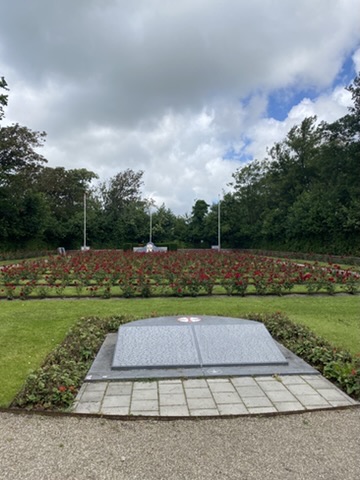
It was a breezy but sunny day. I was rather tired from cycling much further than expected - then we arrived. A quiet, forested cemetery full of rows of stones, it lay lower, so the wind from the sea couldn't reach me here. Nor could anything else - contrary to what I had believed before arriving, there were no other people here besides me. Maybe because they didn't know what happened here? I wasn't too sure.
When Nazi Germany invaded the Soviet Union in 1941, the quick blitzkrieg was no match for the half-prepared Soviets. One of these Soviets was Shalva Loladze, an Air Force commander at the start of the war. When his plane was shot down over Ukraine and he was captured by the Germans, he had the choice to either become a Prisoner of War (POW) - which meant abuse, starvation, and even death - or serve in the German military and be relatively well fed. He chose the latter and was eventually sent to the Dutch island of Texel, which was part of the German "Atlantic Wall". The Georgians stationed here together with Loladze were promised that after a German victory over the Soviets, there would be an independent Georgian state. When it became clear in late March 1945 that the Axis powers were not going to win, Loladze, together with local resistance leaders, began scheming for an uprising on the island.
Right after midnight on the night of 5-6 April 1945, the Georgian Legion, together with local resistance members, took control of almost all of the island. Many historians agree that almost 200 German soldiers were killed in this initial push. Unfortunately, the uprising depended on an expected landing by the Allied powers, which did not happen. The Georgian Legion also failed to capture important naval batteries on the northern and southern sides of the island.
Almost 2,000 German riflemen were deployed to the island to combat the rebellion. Over the span of five weeks, these Germans retook the island; fighting was particularly fierce around the island's lighthouse. After the heavy fighting, German troops combed the entire island for any remaining Georgian troops, whilst local townsmen tried to hide them. Many Georgians were indeed captured and had to dig their own graves, remove their uniforms, and be put to death. During the rebellion, at least 565 Georgians, 120 residents of Texel, and 812 Germans were killed.
From the end of the war until the fall of the Soviet Union, the Soviet ambassador to the Netherlands visited the graves of the Georgians every 4th of May (Dutch Remembrance Day). So how did local inhabitants forget what happened here? It's mostly due to the decline of the Dutch Communist Party, which had played a major role in keeping the memory of the uprising alive.
I mostly came to this cemetery to see Soviet memorabilia, but was left with a feeling of remembrance and respect for the Georgians who died in the rebellion.
Outside the treeline, the wind picked up again. Inside, 565 men remain exactly where the silence left them.
← Back to all postsWebmentions
No webmentions yet. Be the first to respond!